In the summer of 2015, Josiah's hearing continued to come into question. Though no serious hearing loss was found, the recommendation for hearing aides were present. As I tend to do nothing without full disclosure of information and examination, Carl and I asked that structural abnormalities be ruled out. If Josiah's hearing loss was a result of an easily fixable abnormality, we wanted to examine that road first. So, with no questions asked, a CT (cat scan) was ordered to examine the structural interior of Josiah's ears. The result: no structural abnormalities found supporting a surgical option. Instead, the CT scan made note of an unusual density to his cerebellum. Further imaging, via MRI, was recommended.
Carl and I spent many an hour researching "unusual density to cerebellum". The results left us no more certain about the meaning of these unusual findings. "It could be something." "It could be nothing." "It could be related to the Down syndrome." That's a clear as picture as we could form. As Fall proceeded, Josiah was fitted for hearing aides. We continued to wonder about the mystery now facing our son. Carl passed. Time passed. In early December, I found myself driving Josiah to a local Children's Hospital for a scheduled MRI. Josiah was sedated for the procedure, they obtained the necessary images, Josiah endured without complaint or complication. I continued with life, still wondering what the findings might show.
In mid-December, I received the results of the MRI. Although Josiah's brain looks different than an average brain, it looks "typical" for a child with Down syndrome. Josiah has more white matter than those without DS, but typical of a person with DS. I theorized that this might explain why people with Down syndrome are more likely to develop dementia in their 30's or 40's. The MRI showed that Josiah had fluid in his right ear (which was infected). There were the previously noted abnormalities within the structure of his ear but masses and tumors were ruled out. There was, surprisingly, evidence of an old brain bleed - as evidenced by staining on the brain. They stressed that it was old. It could've happened during child birth or as a result of very early pulmonary hypertension. Regardless, they voiced that it was not a current concern. No lesions, tumors, masses, or fluid on the brain were found. I called the neurology department and scheduled an appt for early January to discuss the findings and, more importantly, learn how these findings could impact Josiah.
The January appointment was cancelled by Children's. They had talked to Josiah's pediatrician and were determining the best follow up plan. I had the information (above) but still no clear cut answers as to what it all meant. It took well over 2 months, but a follow up was finally scheduled for March.
In the wee hours, on a March morning, Josiah & I headed to the Children's Satellite location where we met with a neurologist and hematologist from the stroke clinic. Yes, stroke clinic! I finally received the clear-cut answers I was seeking.
Josiah had numerous strokes, as evidenced by gray matter in two lobes of his brain - the parietal lobe & the cerebellum. The parietal lobe controls the "gps of the mind" - spacial awareness, ability to see peripherally, etc. The cerebellum controls balance. There were numerous areas of gray matter, consistent with numerous 'remote' strokes. They are all old. Although they, technically, damaged parts of Josiah's brain, they caused no ill effects. Their best guess is that these remote strokes happened around the time of Josiah's open heart surgery - likely when he was on the bypass machine.
So, it is believed that Josiah had two kinds of strokes: ischemic arterial stroke & a venous stroke. Due to the areas of the brain that were damaged, they did little to cause problems for Josiah. Through historical documentation, as well as tests they performed, they do not believe Josiah's balance or 'gps' system have been negatively impaired. Josiah's strokes are considered "silent strokes" as they happen, unbeknownst to anyone, and cause no impairment. In a child who has had an ischemic arterial stroke (the one that generally impairs the gps system), a young child's brain will often re-map itself so the damaged area is of no consequence. This is what they believed happened with Josiah.
The extra white matter, in Josiah's brain? Not related to Down syndrome. Rather, it is damage to the cells as a result of the earlier strokes. The believe these strokes were a one-time incident. They do not believe he is at risk for any further strokes.
They will perform another MRI at the end of 2016 to make sure there are no additional changes. If the 2 images look the same, no further follow up will be required.
Though stunned to learn Josiah had suffered from numerous strokes, I am thankful that these findings were discovered by accident. It was not symptoms that drove us searching for answers, it was a Mom & Dad who simply wanted to rule out a structural abnormality within their son's ears.
I remain in awe of this beautiful soul. Blessed with an extra chromosome, he courageously fought RSV, open heart surgery, and numerous remote strokes. His brain? It just remapped itself; No problem.
As I continue to climb up the down staircase, I remain in complete admiration. I continue to smile at a life so precious. I continue to point to the stars because nothing's going to stop Josiah from reaching his full potential :)
Showing posts with label chromosome. Show all posts
Showing posts with label chromosome. Show all posts
Saturday, August 20, 2016

Tuesday, October 1, 2013
31 for 21 Challenge: Day 1: DS Awareness
October marks Down syndrome awareness month. I have decided to, once again, participate in the 31 for 21 challenge. This means that each day during the month of October, I will post a fact/thought/etc about Down syndrome. It is all in an effort to raise awareness for Down syndrome.
I was twelve weeks pregnant, when the word 'markers' was used as a warning. A routine test indicated that the skin of the back of Josiah's neck was too thick. This was the first possible sign of a 'problem'.
As the next several weeks passed, more markers became evident. Josiah's leg and arm bones appeared shorter than 'normal.' The bridge to his nose appeared (possibly) flatter. He appeared to have a hole in his heart. As the number of markers grew, so did the chance of a Trisomy 21 diagnosis.
At 19 weeks gestation, we decided to have amnio. We hadn't had the test with our first two boys. This time, it seemed the responsible thing to do. We knew it would either confirm or disprove the theory of a chromosomal abnormality.
48 hours after the amnio, our OB called. I think it was the only time he has ever called our house. The preliminary report was in. Josiah, in fact, had three copies of the 21st chromosome.
We were relieved that it was Down syndrome. Trisomy 13 or Trisomy 18 were two possibilities we had feared. It was neither; We were relieved. That was on a Wednesday.
On Sunday, we decided to share the news with family.
At no time did we ever consider the possibility that we wouldn't keep, and raise, this life we had been gifted. Any suggestions to the like we immediately, and vehemently, discarded.
As Josiah nears his second birthday, I remain in awe of a beautiful boy with an extra chromosome. He has added life, love, laughter, and spirit to our home and family.
We have no regrets.
I was twelve weeks pregnant, when the word 'markers' was used as a warning. A routine test indicated that the skin of the back of Josiah's neck was too thick. This was the first possible sign of a 'problem'.
As the next several weeks passed, more markers became evident. Josiah's leg and arm bones appeared shorter than 'normal.' The bridge to his nose appeared (possibly) flatter. He appeared to have a hole in his heart. As the number of markers grew, so did the chance of a Trisomy 21 diagnosis.
At 19 weeks gestation, we decided to have amnio. We hadn't had the test with our first two boys. This time, it seemed the responsible thing to do. We knew it would either confirm or disprove the theory of a chromosomal abnormality.
48 hours after the amnio, our OB called. I think it was the only time he has ever called our house. The preliminary report was in. Josiah, in fact, had three copies of the 21st chromosome.
We were relieved that it was Down syndrome. Trisomy 13 or Trisomy 18 were two possibilities we had feared. It was neither; We were relieved. That was on a Wednesday.
On Sunday, we decided to share the news with family.
At no time did we ever consider the possibility that we wouldn't keep, and raise, this life we had been gifted. Any suggestions to the like we immediately, and vehemently, discarded.
As Josiah nears his second birthday, I remain in awe of a beautiful boy with an extra chromosome. He has added life, love, laughter, and spirit to our home and family.
We have no regrets.
Tuesday, October 23, 2012
31 for 21 Blog Challenge: DAY NINETEEN: A Poem
This poem really touched my heart <3
When you were but a tiny speck
deep within my womb
something happened to your cells
as life began to bloom
a chromosomal anomaly
is what the doctors say
but you are EXACTLY what I asked for
each night as I would pray
"Dear Lord, send me a happy child
who will not grow up too fast,"
for I love the joys of childhood
and I wanted that to last.
'Send me a child who sleeps all night
and doesn't often cry,
a little boy with endless love
and a willingness to try."
That little extra chromosome
that number 21
gave me all I ever wanted
YOU - my precious son
- author unknown
Friday, June 8, 2012
Friday's Facts 060812: Feet
Children with Down Syndrome can experience a wide array of orthopedic issues. This is due to their tendency for loose ligaments and hypotonia (decreased muscle tone). This can include: scoliosis, joint dislocation, hop and knee cap instability, weak ankles and problems with the feet such as flat foot and 'metatarsus primus varus'.
FLAT FEET is seen in the majority of people with Down Syndrome. Flat feet is a condition in which the arch of the foot 'collapses.' Most flat feet do not cause pain or other problems. In children, the diagnosis of flat foot is often not determined until the child reaches the age of 4-6.

METATARSUS PRIMUS VARUS is also very common in people with Down Syndrome. The condition is explained as the front part of the foot, behind the big toe, bends inward. Most cases can be treated with orthotics.

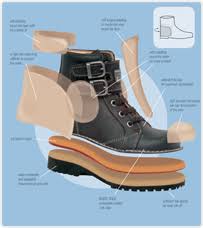
ORTHOTICS: There are two prominent types of orthotic shoes that are widely used for children with disabilities. They are:

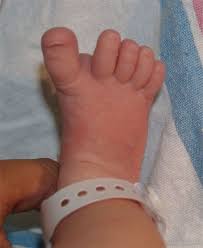
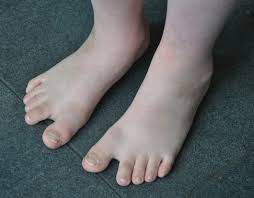
Additionally, people with Down Syndrome often have slightly shortened toes, small wide feet, and/or a slightly enlarged gap between the big and second toe (as shown here):
*pics obtained from the Internet *
FLAT FEET is seen in the majority of people with Down Syndrome. Flat feet is a condition in which the arch of the foot 'collapses.' Most flat feet do not cause pain or other problems. In children, the diagnosis of flat foot is often not determined until the child reaches the age of 4-6.
METATARSUS PRIMUS VARUS is also very common in people with Down Syndrome. The condition is explained as the front part of the foot, behind the big toe, bends inward. Most cases can be treated with orthotics.
ORTHOTICS: There are two prominent types of orthotic shoes that are widely used for children with disabilities. They are:
- PIEDRO BOOTS are designed for children who need an extra arch or ankle support.
- RICOSTA is a leading German brand of children's shoes. They are made of high quality leather and have lightweight soles.
Additionally, people with Down Syndrome often have slightly shortened toes, small wide feet, and/or a slightly enlarged gap between the big and second toe (as shown here):
*pics obtained from the Internet *
It's amazing how one little extra chromosome, can alter something like a foot :)
Friday, April 20, 2012
Friday's Facts 042012: Some Basic Statistics
Some basic statistics:
1. Down Syndrome is also referred to as Trisomy 21. It is caused by an extra 21st chromosome.
2. It is named after John Langdon Down, a British physician who described the syndrome in 1866.
3. Life expectancy for someone with Down Syndrome has increased from 12 years (in 1912) to 60 years. *In March 2012, the Guiness Book of World Records website listed Joyce Greenman, now 87, of London, who was born on 3/14/1925, as the oldest living person with Down Syndrome.
4. 1 in 691 babies, overall, are born with Down Syndrome (0.12%)
<1 in 1000 in women under the age of 30
1 in 400 for women between the ages of 35-40
1 in 110 for women over 40
1 in 25 for women over 45
5. 88% of cases arise from the mother's chromosome 21; 8% arise for the father's chromosome 21; 2% from 'mitotic errors after fusion.'
6. Translocation Down Syndrome occur in 4-5%.
7. 80% of Down Syndrome children are born to women under the age of 35 in the U.S.
8. 40-50% of children with Down Syndrome have cogenital heart defects in the U.S.
9. Having Down Syndrome increases the risk of Leukemia 10-15% in the U.S.
10. 100% of people with Down Syndrome will develop physiological signs of Alzheimer's after the age of 35 in the U.S.
11. In the U.S., it is referred to as "Down Syndrome." In the U.K., it is referred to as "Downs Syndrome."
12. 66-89% of individuals with Down Syndrome have some level of hearing loss in at least one ear.
13. The risk of pneumonia is 62 times higher than in non-Down Syndrome individuals.
14. Seizures occur in 3-13% of individuals with Down Syndrome.
15. There are more than 400,000 people living with Down Syndrome in the U.S.
Saturday, November 5, 2011
The birth of Josiah
October 12, 2011: Josiah was born at 5:50pm. He was 19.5 inches long; he weighed 7lbs 0.4oz. He is a beautiful baby. He may have an extra chromosome, but he is absolutely perfect! Our new adventure has begun....
Subscribe to:
Posts (Atom)